This content is intended for the public covered by the exceptions of the Charter of the French language and its regulations. If you read on, you confirm that you fall within one of these exceptions.

Flooding and spring freshets
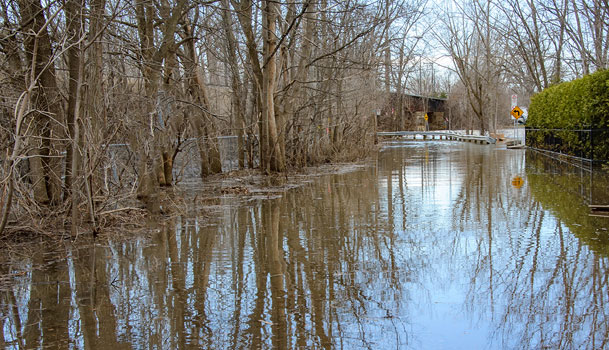
The risk of flooding is persistent on an island bordered by two major rivers. Find out how to prepare.
When and where is there a risk of flooding?
Certain areas are more prone to flooding, particularly those near rivers. Flooding often occurs during the spring freshet between March 15 and May 15. The flood risk is always higher in the presence of violent weather events, including high winds, storms, tornados and hurricanes.
Sudden heavy rainfall and severe thunderstorms, which are more frequent in summer due to hot and humid weather, can cause localized flooding.
There are several ways to protect yourself and mitigate the damages caused by flooding:
- Contact your insurer to check your coverage in the event of backflow, groundwater infiltration, and a river overflowing.
- If your home is on a floodplain: During the spring freshet, arrange your basement in such a way that objects of value are high off the floor, or bring them up to ground level, if possible.
- Regularly clean your gutters to ensure proper rainwater drainage, and direct them toward a permeable surface, such as your lawn.
- Clear any obstacles to the evaluation of water through the sewer inlets and drains (ice, branches, leaves, etc.).
- Check to make sure that your sump pump is working properly and your sewer check valve is watertight.
- Prepare your family safety plan and a ready-to-go emergency bag in the event that you must evacuate. Also keep on hand all the items you need to ensure your autonomy for a minimum period of 72 hours.
- Safely store objects that could be swept away by the current (garden furniture, dock, etc.).
- Find out in advance where you can find refuge (with family, friends, etc.).
- Protect building entrances (windows, doors, garage, etc.) by creating a dike (low wall) using sandbags. How to build a low wall (PDF, 558 KB – in French). Learn about the Government of Québec’s general financial assistance program and the grants that may be available
- Take detailed photographs of your property and property items before any disaster strikes. Keep the photos in a secure cloud storage service or on a USB key kept outside of your home.
- Contact 911 to report a situation in which the life, health and safety of a person is threatened.
- If the situation is serious, leave your home before the streets become impassable. In doing so, you won’t have to drive through floodwaters.
- Shut off the power if water begins to rise close to electrical components. When cutting the power, make sure your feet are on a dry surface and use a wooden stick to cut the power and thus avoid contact with the electrical panel. If necessary, contact a master electrician.
- Shut off the main natural gas inlet as well as the valves on propane and fuel oil tanks. Make sure that they are solidly anchored to the ground if there is a risk that they will be flooded.
- Electrical installations that come into contact with water may pose a risk of electrocution or fire. Immediately notify Hydro-Québec, which will cut the power.
- Stay away from downed power lines and wires, even if there is a power outage.
- If water backs up from the floor drain or the sewer pipes, block the inlets with a cloth.
- If you don’t own a pair of tall boots, avoid walking in floodwaters, as they can be dangerous and contaminated.
- You can install pumps to evacuate the water from your home or the edge of your sandbag dike. To avoid carbon monoxide poisoning, never use a motorized pump, generator or any other gas-powered device (propane, fuel, diesel) inside your home.
- Comply with the safety guidelines issued by public authorities.
When to contact 311?
- When your home is flooded
- When you leave your home
- When you return home
- To request information
After a flood
- Contact your insurance company.
- Do not consume the tap water until you receive authorization from the city. When first turning on the tap, let the water run for a few minutes. Check to make sure that the well water is safe before drinking it.
- Disinfect objects, foods and medications that come into contact with flood waters.
- Have the electrical installations and heating appliances checked by a master electrician before reconnecting them.
- Watch for the presence of mould. If necessary, call upon a specialized company.
- Draw up an inventory of the damages and take photos clearly demonstrating the height that the water reached, then inform your insurer and the City of Laval.
- Quickly demolish and decontaminate the parts of your house that have been flooded in order to avoid mould. If necessary, call upon a specialized company.
- Check if you are eligible for the Government of Québec’s general financial assistance program.
- Document all the steps that you take and keep receipts for cleaning and repair work for your insurance records.
- Don’t forget to regularly update your photos and store them in the cloud or on a USB key, particularly after renovating or purchasing property items of high value.
- Contact 211 to receive help from community-based organizations, based on your needs.
What to do for your home after a flood?
Refer to the guide prepared by the Société d’habitation du Québec (In French) to learn what steps to take for your home following a flood.
How to validate building sanitation and safety
After a water infiltration into a home, it is important to act quickly to limit the formation of mould, as its dispersal into the air can lead to health problems.
Be careful for the:
- Smell of mould, earth or alcohol.
- Signs of spotting (green or black) on the walls or ceilings, in the cupboards or behind items that have not been removed.
View the document entitled What to do in your house after a flood (in French)
Learn about finding and eliminating mould from your home
Information about mould
Rebuilding after a flood
- The owner of a structure that is damaged must take the necessary measures, without delay, to secure the premises and avoid mould.
- No construction permit is required to remove finishing materials (e.g., floating floors or door frames) affected by flooding.
- Some work, such as painting, does not require a permit, since it is considered maintenance work.
- If you undertake major work that affects the structure of your home, please contact the Service de l’urbanisme to submit an application for a renovation or transfer permit.
How waterways are monitored
Want to find out how waterways are monitored? The City of Laval has installed 14 telemetric stations at strategic locations around Île Jésus. These stations monitor water levels and issue alerts.
A camera was also installed to monitor certain situations. These data are not available in real time, as they must first be validated and interpreted. To improve monitoring, the City of Laval also has access to government soundings.
The following tools can also be used to monitor water flow:
- Forecasts from the Ministère de l’Environnement, de la lutte contre les changements climatiques, de la faune et des parcs du Québec.
- Active flooding in the last 72 hours from Natural Resources Canada.
