This content is intended for the public covered by the exceptions of the Charter of the French language and its regulations. If you read on, you confirm that you fall within one of these exceptions.

Accidents involving hazardous material
While a major accident involving hazardous materials is highly unlikely, it can entail serious consequences for human health and the environmen. What to do in the event of an alert.
Risks of an accident
These accidents can occur during:
- The transportation of hazardous materials (by truck, train, or pipeline)
- The activities of a company that uses and/or stores such materials.
Possible health effects in the event of a toxic substance release
A release of toxic substances can cause:
- of the respiratory tract
- of the skin
- of the eyes
Possible health effects in the event of an explosion or a fire
An explosion or fire can lor a fire can result in:
- Severe burns
- Injuries caused by projectiles
What to do in the event of a toxic substance release or a risk of explosion?
In the event of a spill, a leak, or an explosion involving chemical products authorities may ask residents to shelter at home lockdown or evacuate the premises.
If authorities request that residents shelter in place :
- Close and seal the doors and windows with tape.
- Stay far from openings.
- Shut off the ventilation (air conditioning, range hood, dryer).
- Block the air intakes with damp cloths.
- Monitor the situation via the media or 311.
- Only use the phone in case of emergency.
- Stay indoors until you receive authorization to go out.
- Leave your loved ones where they are. On-site staff know the procedures to follow.
Alert sirens installed within Laval city limits
Industries within Laval city limits are equipped with alert sirens. In the event of a major accident involving the release of a toxic substance or a risk of explosion, the siren serves as a warning to residents to take shelter.
The siren emits an ascending and descending sound signal lasting three minutes.
What to do when the alert siren sounds
- Close and seal the doors and windows with tape.
- Stay far from openings.
- Shut off the ventilation (air exchanger, air conditioning, range hood, dryer).
- Block the air intakes with damp cloths.
- Monitor the situation via the media or 311.
- Only use the phone in case of emergency.
- Remain indoors until you receive authorization to go out.
- Leave your loved ones where they are. On-site staff know the procedures to follow.
Emergency measures planning zones
Emergency measures planning zones (EMPZ) are established in accordance with potential consequence modelling (release of toxic substances, explosion) for each industry. These zones determine the sphere of action of local authorities in the event of a major accident.
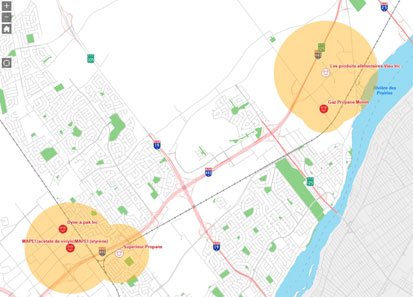
To check whether your address is within an EMPZ:
Industries with an alert siren
Under municipal bylaw L-12933, industries subject to federal Environmental Emergency Regulations are required to have a siren and an environmental emergency plan.
These industries are located in an Emergency Measures Planning Zone (EMPZ), i.e., a given industry’s largest impact.
Dyne-a-Pak Inc.
- Hazardous materials: mixture of isopentane, isobutane
Gaz Propane Monin
- Hazardous material: propane
MAPEI Inc.
- Hazardous materials: styrene, vinyl acetate
Supérieur Propane
- Hazardous material: propane
Produits Alimentaires Viau inc.
- Hazardous material: ammonium hydroxide
Industrial prevention measures
The risk of a major industrial accident remains low thanks to the following prevention and risk management measures:
- Continuous release detection system
- Regular preventive maintenance on equipment
- Ongoing staff training
- Environmental emergency plan
