This content is intended for the public covered by the exceptions of the Charter of the French language and its regulations. If you read on, you confirm that you fall within one of these exceptions.

Fencing for existing swimming pools (new standards)
The government has updated the regulations to reduce the risk of accidents and drowning.
The new standards apply to all pools (above-ground, in-ground, portable), including those installed before 2010. The installation must be compliant by September 30, 2025.
Applicable standards
Bylaw L-280 concerning the construction of fences around swimming pools and Bylaw L-11807 concerning pool safety have been repealed. They have been replaced by transitional By-law L-12907 which ensures that existing installations are maintained or rebuilt in compliance with provincial regulations by September 30, 2025.
Pools installed before November 1, 2010
- Installations must be compliant by September 30, 2025.
- To find out whether your existing installations are compliant, read the Ministère des Affaires municipales et de l’Habitation self-assessment form that corresponds to your situation.
- To find out which standards apply to a pool or spa, see the Quebec government’s explanatory document (PDF, 1,22 Mo).
Pools installed between November 1, 2010 and July 1, 2021
- No changes required for installations that comply with Bylaw L-11807
- Pools purchased before July 1, 2021 and installed between July 1 and September 30, 2021, must comply with Bylaw L-11807.
Pools purchased and installed after July 1, 2021
- Read the applicable provincial regulation on home pools.
Preventing access to the pool
All homeowners must ensure that their swimming pools comply with current regulations. The safety of your family, friends and guests depends on it.
Pools or spas over 2,000 litres must be enclosed to prevent access.
- Spas (Must be protected by a solid, rigid cover to prevent access when not in use).
- In-ground and semi-in-ground pools (must be enclosed by fencing to prevent access).
- Above-ground pools with a wall height of less than 1.2 m and portable pools with a wall height of less than 1.4 m must be fenced off to prevent access.
- Above-ground or portable pools do not need an enclosure if access to the pool is by:
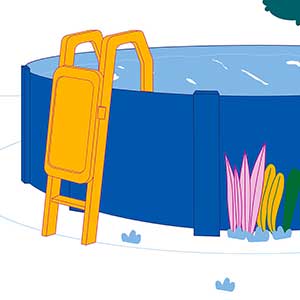


Automatic closing and locking device mandatory
Every gate in a fence must be fitted with a passive safety device that automatically closes and locks the door.

Applicable standards for springs and latches

The enclosure gate must open and close automatically by means of a spring.

The latch should engage automatically when the door is closed.

When the latch is on the outside of the enclosure, it must be installed at a height of 1.5 m or more from the ground.
Minimum height of enclosure
In the case of a new pool adjacent to an existing balcony or patio, the existing guardrail must be replaced or modified to comply with the mandatory minimum height of 1.2 metres, according to residential pool safety regulations.
Applying for a permit
Before applying for a permit, make sure you have all the required documents. Also, please read the current regulations and plan where to place the installation. You should also find out what safety measures you need to take.
1 – Read the applicable standards above.
2 – Choose where to install the enclosure
Find a location that complies with current regulations. The pool enclosure must be at least 1.2 m (4 ft.) high and a minimum distance from buildings and other installations on your property.
3 – Prepare a layout plan
Draft a precise plan showing the pool and the enclosure. .
- Location of pool in relation to building and property limits
- Existing trees and trees to be felled with their diameter breast height (tree trunk diameter at 1.3 m from the highest ground level)
- Distance from property limits
- Distance from all permanent structures
- Location and height of enclosure
4 – Gather the necessary documents
The following documents are required:
- Application form for pools and spas (PDF, 466 ko) completed and signed
- Plan d’implantation à l’échelle préparé par le requérant
Le plan doit représenter la situation existante et il doit être récent. - Layout plan to scale prepared by applicant
The plan must represent the existing situation and be recent.
Certificate of location prepared by the land surveyor.
It must represent the existing situation and be recent.- In flood plains or riverside areas:
- Identify the shoreline
- Identify flood levels
- Delineate flood zones, the special intervention zone (ZIS) and highest known flood levels (PHEC).
- Photo of the yard where the pool will be installed.
Please include photos of the backyard, balcony and back wall showing the openings (doors and windows) are required. - Power of attorney (PDF, 38 ko)(if you are not the owner)
Once you have gathered all the necessary documents, you can apply for a permit to install a pool enclosure.
After submitting your permit application
You will receive an email concerning the status of your application within five business days.
- If your application is complete: You will receive a file number and an account statement, which you must pay on receipt.
- If your application is incomplete: We will send you a notice of refusal, including a list of the missing documents. You will then have to submit a new application with all the required documents.
Pay your permit application fees using the online Permit/Certificate Payment service.
Wait until you have received your permit before starting the work.
Display your permit for the duration of the work. It must be visible from the street. In addition, secure your work site to minimize the risk of accidents and drowning.
During the visit, the inspector will assess whether the work is compliant.
Good to know
If you cannot submit your permit application online, you may submit it in person at:
Service de l’urbanisme
1333, boulevard Chomedey
Rez-de-chaussée
Laval (Québec) H7V 3Z4
Please make an appointment before visiting the office.
During your work, you may discover archaeological remains (structures or objects) on your property.
Quebec’s Cultural Heritage Act requires anyone who discovers an archaeological object or remains to report it to the Ministère de la Culture et des Communications immediately.
There are three ways to report your archaeological find:
- Complete the notice of discovery form (in French) available on the Quebec government website.
- Call the regional directorate for Laval, Lanaudière and the Laurentians of the Ministère de la Culture et des Communications at 450 430-3737.
- Send an email to: [email protected].
